A Chilled Water System is a central cooling system used in large buildings such as offices, hospitals, airports, shopping malls, and industrial facilities to provide air conditioning. Instead of using direct expansion (DX) units like split or packaged units, chilled water systems use water as the cooling medium, which is chilled by one or more central chillers and circulated throughout the building to cool spaces via air handling units (AHUs) or fan coil units (FCUs).
🔑 Key Objectives of a Chilled Water System
Efficient cooling of large spaces.
Centralized control of cooling operation.
Energy-efficient distribution of cooling.
Scalability for future expansion.
📊 Basic Concept of Operation
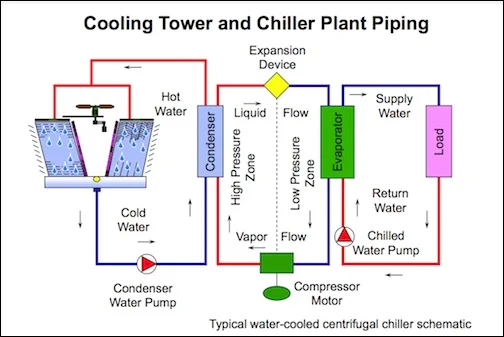
Chillers cool water to a low temperature (typically 42°F to 45°F / 5.5°C to 7.2°C).
The chilled water is pumped via piping to various parts of the building.
At each space, heat exchangers (like AHUs or FCUs) use the chilled water to cool air that is then circulated within rooms.
The warmed water (after absorbing heat) returns to the chiller to be cooled again — completing the loop.
⚙️ Main Components of a Chilled Water System
Component
Function
Chiller
Produces chilled water by extracting heat from water.
Chilled Water Pumps
Circulate chilled water through the piping network.
Condenser Water Pumps
Circulate water between the chiller and cooling tower (for water-cooled chillers).
Cooling Tower
Rejects heat from condenser water to the atmosphere.
AHUs/FCUs
Terminal units that cool air using chilled water.
Piping System
Network to distribute chilled water.
Expansion Tank
Absorbs volume changes in the system as water temperature changes.
Control Valves
Regulate flow to terminal units.
📏 Why Use a Chilled Water System?
Efficiency: Chilled water systems can serve large and multiple spaces more efficiently than decentralized DX systems.
Scalability: Easy to add capacity (more chillers, AHUs) as building needs grow.
Flexibility: Centralized cooling plants can be optimized for energy savings.
Space-saving: Terminal units like FCUs take up less space than full DX systems in each room.
Maintenance: Centralized maintenance of equipment reduces operational complexity.
🏢 Applications of Chilled Water Systems
Sector
Examples
Commercial Buildings
Offices, malls, airports
Healthcare
Hospitals, laboratories
Educational Institutions
Schools, universities
Industrial Facilities
Factories, data centers
Hospitality
Hotels, resorts
🧠 Basic Terminologies to Know
Term
Meaning
Tons of Refrigeration (TR)
Cooling capacity unit (1 TR = 12,000 BTU/hr).
GPM (Gallons per Minute)
Flow rate of chilled water in system.
ΔT (Delta T)
Temperature difference between supply and return water.
Primary/Secondary Loop
Piping arrangement to manage flow and load distribution.
Variable Speed Drive (VFD)
Device to adjust pump/chiller speed for energy efficiency.
🔍 Focus of Chilled Water System Design
When designing a chilled water system, engineers focus on:
Accurate cooling load estimation.
Proper selection and sizing of chillers, pumps, and piping.
Efficient distribution and control strategies.
System redundancy and reliability.
Energy conservation measures to reduce operating costs.