


1. Course Overview
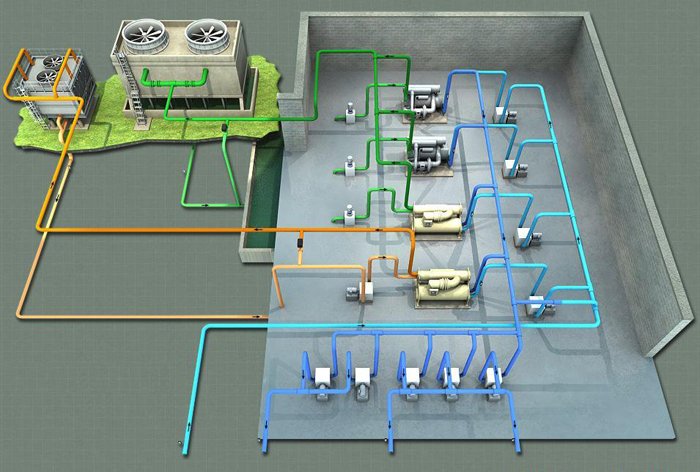
This course equips learners with the knowledge and skills to design, draft, and manage chilled water HVAC systems for commercial, residential, and industrial applications. The program covers theory, codes of practice, design steps, drafting techniques, software integration, and case studies.
Target Audience:
- MEP Engineers
- HVAC Designers & Drafters
- Facility Managers
- Graduate Mechanical Engineers
Duration: 8–10 weeks (Flexible: Beginner to Advanced)
Mode: Online / Classroom + CAD Lab
Learning Outcomes:
- Understand fundamentals of chilled water systems.
- Perform load calculations and equipment selection.
- Design piping networks, pumps, and control systems.
- Draft complete system layouts in AutoCAD/Revit.
- Apply codes, standards, and energy efficiency guidelines.
2. Course Modules
Module 1: Introduction to Chilled Water Systems
- What is a chilled water system?
- Applications in high-rise buildings, hospitals, and data centers.
- Comparison with DX and VRF systems.
- Key components: chillers, pumps, piping, cooling towers, AHUs, FCUs.
Module 2: Heat Load Estimation
- Basics of HVAC load calculation.
- Internal vs external heat loads.
- ASHRAE standards for load calculation.
- Case study: load estimation for a commercial office building.
Module 3: Chillers
- Types of chillers: Air-cooled vs Water-cooled.
- Classification by compressor type: centrifugal, screw, scroll.
- Efficiency parameters (COP, IPLV).
- Chiller selection procedure.
Module 4: Chilled & Condenser Water Pumps
- Functions of chilled water pumps.
- Head calculation & pump selection.
- Primary, secondary, and tertiary pumping.
- Variable Flow vs Constant Flow systems.
Module 5: Cooling Towers (for water-cooled systems)
- Working principle.
- Types: counterflow, crossflow, induced draft.
- Cooling tower selection.
- Water treatment and chemical dosing.
Module 6: Piping Design
- Chilled water piping layouts (direct return, reverse return).
- Pipe sizing methods (velocity method, friction loss method).
- Pressure drop calculation.
- Expansion tanks, air vents, strainers, valves, insulation.
Module 7: Air-Side Equipment
- Air Handling Units (AHUs).
- Fan Coil Units (FCUs).
- Terminal units (VAVs, CAVs).
- Integration with duct systems.
Module 8: Controls & Automation
- Building Management System (BMS).
- Chiller Plant Manager (CPM).
- Control valves, sensors, and actuators.
- Energy efficiency measures (VFDs, optimization).
Module 9: Drafting & Documentation
- Introduction to HVAC drafting standards.
- Layering, symbol conventions, schematic diagrams.
- AutoCAD/Revit MEP tools for chilled water design.
- Preparing single-line diagrams, riser diagrams, and shop drawings.
Module 10: Codes, Standards & Best Practices
- ASHRAE, SMACNA, and local codes.
- Sustainability and green building requirements.
- Case study: chilled water system in a LEED-certified building.
Module 11: Case Studies & Project
- Chilled water system for a high-rise office tower.
- Hospital chilled water system with redundancy.
- Data center chilled water system with precision cooling.
3. Practical Sessions
- Hands-on load calculation (using HAP/TRACE software).
- Chiller and pump selection exercise.
- Piping layout drafting in AutoCAD/Revit.
- Pressure drop and pump head calculation exercise.
- Drafting of a complete chilled water schematic.
4. Assignments & Assessments
- Assignment 1: Load calculation for a commercial building.
- Assignment 2: Pipe sizing and pump selection.
- Assignment 3: Drafting riser diagram in CAD.
- Quiz after each module.
- Final Project: Complete chilled water system design & drafting for a multi-story building.
5. Certification & Benefits
- Certificate of Completion (with project evaluation).
- Industry-recognized skills for HVAC/MEP career growth.
- Eligibility for roles in design firms, contracting companies, and facility management.


