
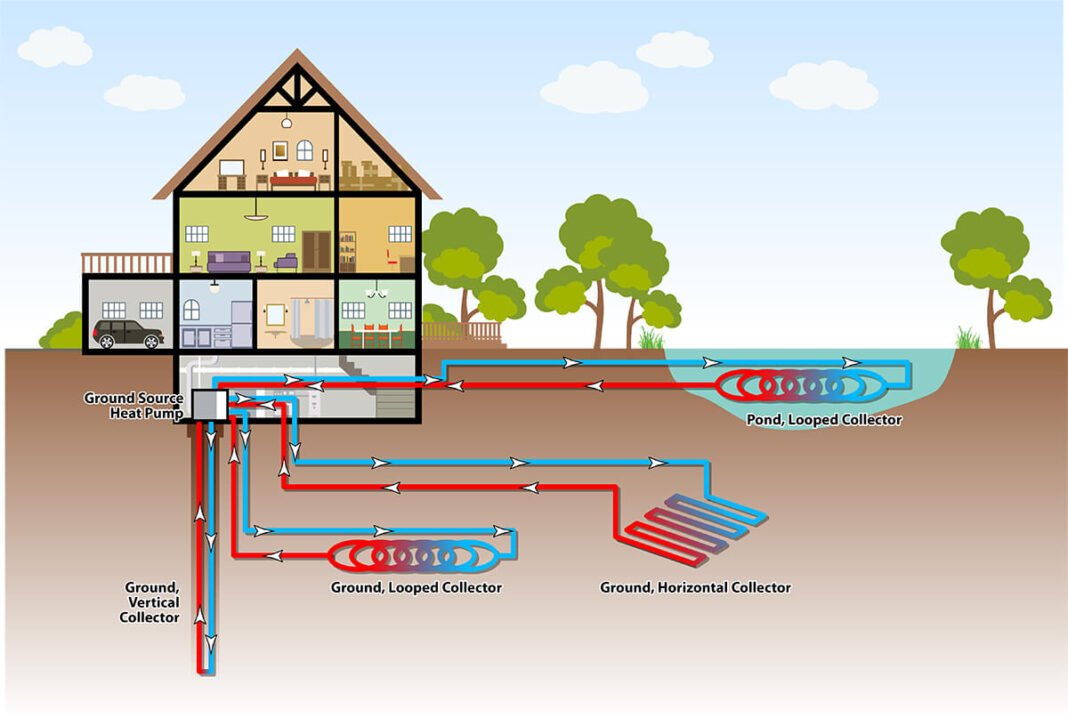
A Hybrid Geothermal Heat Pump (GHP) system combines a ground-source geothermal loop (vertical or horizontal borefields, ponds, or wells) with a supplementary conventional system (such as a cooling tower, boiler, or air-source chiller/heat pump).
- The geothermal loop handles the base load (most of the heating/cooling demand).
- The supplemental system covers peak loads when the ground loop alone isn’t sufficient.
👉 This hybrid approach reduces the borefield size and cost while still delivering the majority of benefits from geothermal energy.
🔹 System Components
- Ground Heat Exchanger
- Vertical boreholes or horizontal loops in soil, rock, or water.
- Transfers heat with the ground (stable ~10–18 °C depending on region).
- Water-to-Water or Water-to-Air Heat Pumps
- Extract/reject heat from the ground loop.
- Provide heating and cooling to AHUs, FCUs, or radiant systems.
- Supplementary Equipment
- Cooling tower (for peak summer load rejection).
- Boiler (for peak winter heating).
- Sometimes paired with air-source chillers/heat pumps.
- Distribution System
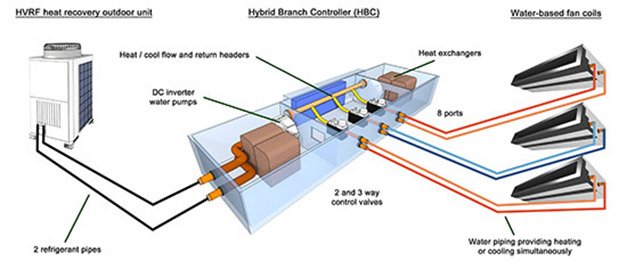
- Hydronic loops (chilled/hot water) to AHUs, FCUs, VRF-like fan coils, or radiant floors.
- Controls & BMS Integration
- Intelligent control decides when to use ground loop vs. supplemental plant.
🔹 Working Principle
- Mild/Normal Load → Heat pump exchanges energy with the ground loop only.
- Peak Cooling → Cooling tower or air-source system rejects excess heat not absorbed by the ground.
- Peak Heating → Boiler adds extra heat when ground cannot supply enough.
- Transition Mode → System balances geothermal + supplemental plant to optimize efficiency.
🔹 Advantages of Hybrid Geothermal Systems
✅ Lower Installation Cost
- Borefield size can be reduced by 30–50% compared to pure geothermal.
✅ High Efficiency
- Still captures most geothermal savings (60–80% of annual load).
✅ Flexibility
- Works in extreme climates where full geothermal would be too large or expensive.
✅ Reliability
- Supplemental plant ensures comfort even under peak loads.
✅ Sustainability
- Lower energy use and emissions compared to all-conventional systems.
🔹 Applications
- Large campuses (universities, hospitals, airports).
- High-rise mixed-use towers with large cooling peaks.
- Data centers where peak cooling is intense.
- District energy systems integrating renewable and conventional sources.
🔹 Comparison: Full Geothermal vs. Hybrid Geothermal
| Feature | Full Geothermal | Hybrid Geothermal |
|---|---|---|
| Borefield Size | Large (expensive) | Smaller (30–50% reduction) |
| Peak Load Handling | All geothermal | Shared (tower/boiler/chiller) |
| First Cost | High | Medium |
| Annual Savings | Very high | High (slightly lower) |
| Best For | Medium buildings, balanced load | Large/peak-heavy projects |
🔹 Example Case
👉 A university campus with 80% cooling load and 20% heating load:
- Full geothermal would require ~600 boreholes.
- Hybrid system with geothermal + cooling tower reduces boreholes to ~350.
- The ground handles heating + base cooling, tower rejects excess summer heat.
- Result: 40% lower installation cost, 25–30% energy savings vs conventional.
✅ In short:
A Hybrid Geothermal Heat Pump system is a cost-effective way to use geothermal energy for most of the year, while relying on a smaller traditional system for extreme conditions—making it ideal for large buildings, campuses, and extreme climates.