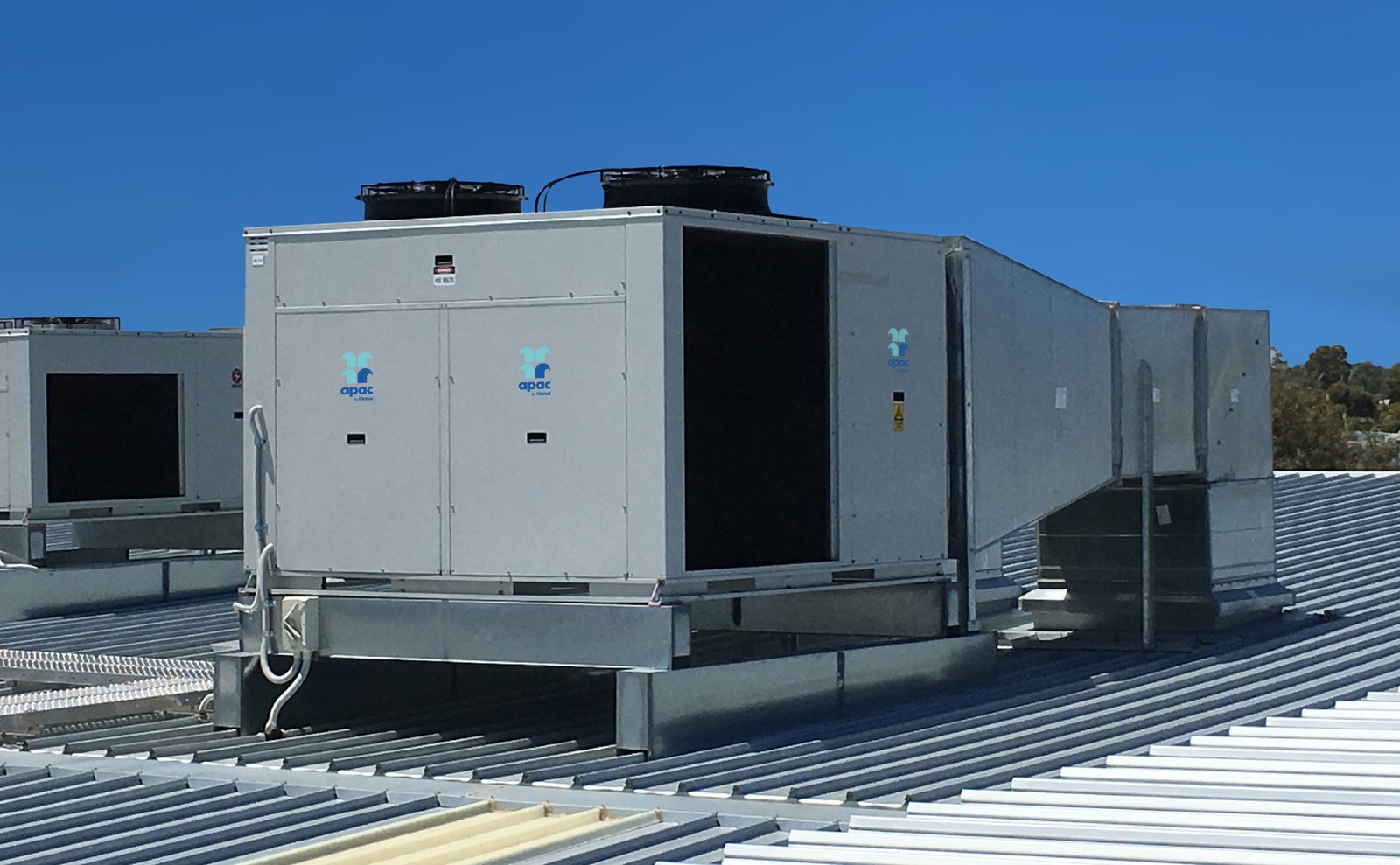
A Rooftop Packaged Unit (RTU) is a self-contained HVAC system placed on the building’s roof, providing cooling, heating, and ventilation.
When made hybrid, the RTU is integrated with renewable energy sources (solar PV, solar thermal, wind, thermal storage, etc.) to reduce reliance on the electrical grid and fossil fuels.
👉 Think of it as a traditional RTU + renewable energy + smart controls, designed for energy efficiency, cost savings, and sustainability.
🔹 Key Hybrid Configurations
1. RTU + Solar PV
- Solar panels on the roof directly power compressors, fans, and controls.
- Excess energy can be stored in batteries or fed to the grid.
2. RTU + Solar Thermal
- Solar thermal panels pre-heat water or air → reducing boiler load for heating or reheat.
- Useful in cold climates or buildings with hot water demand.
3. RTU + Thermal Energy Storage (TES)
- Ice or chilled-water storage integrated with RTU.
- Stores “cheap night-time cooling” → used during peak daytime demand.
- Reduces peak electricity charges.
4. RTU + Desiccant Wheel + Solar Regeneration
- Desiccant wheels remove humidity (latent load).
- Solar thermal energy regenerates the desiccant → reducing compressor use.
5. RTU + Wind + PV Hybrid
- On large campuses or remote areas, small-scale wind turbines + PV feed the RTU, reducing grid dependency.
🔹 Working Principle
- Base HVAC Operation – RTU performs cooling/heating/ventilation as normal.
- Renewable Integration – Solar PV, solar thermal, or TES supplements part of the energy demand.
- Smart BMS/Controls – Decide whether to run on grid, renewable, or stored energy based on load and availability.
- Demand Response – System can lower peak demand charges by shifting load to renewable/TES.
🔹 Advantages
✅ Energy Efficiency & Cost Savings
- Solar PV can offset 20–40% of RTU power demand in sunny regions.
- TES reduces costly peak-hour operation.
✅ Sustainability
- Reduces greenhouse gas emissions.
- Helps meet net-zero energy targets.
✅ Resilience
- Provides partial cooling/heating even during power outages.
✅ Better IAQ & Comfort
- Desiccant + solar regeneration enhances humidity control.
✅ Compliance
- Meets stricter energy codes (ASHRAE 90.1, IECC, LEED, WELL).
🔹 Applications
- Big-box retail stores & supermarkets (large roof areas = ideal for PV).
- Schools & universities (daytime load matches solar profile).
- Hospitals & clinics (critical load + resilience).
- Warehouses & logistics centers (TES integration).
- Remote/off-grid facilities (with solar + wind hybrid RTUs).
🔹 Example Case Study
👉 A 50,000 sq. ft. retail store in Arizona:
- Installed 200 kW rooftop PV system + hybrid RTUs.
- RTUs powered 30–40% by solar in daytime.
- TES provided 6 hours of cooling load shift.
- Annual energy cost reduction: 25% (~$120,000/year).
- Carbon savings: ~300 tons CO₂ annually.
🔹 Comparison: Conventional RTU vs Hybrid RTU
| Feature | Conventional RTU | Hybrid RTU (Renewable Integrated) |
|---|---|---|
| Energy Source | Grid electricity + gas | Grid + Solar PV/Thermal + TES |
| Operating Cost | High | Medium-Low |
| Sustainability | Low | High |
| Peak Demand Control | Limited | Excellent (TES + PV) |
| IAQ & Humidity | Standard | Improved (with desiccant/solar regen) |
| Ideal Use | General buildings | Green, net-zero, large-roof buildings |
✅ In short:
A Hybrid Rooftop Packaged Unit with Renewable Integration is the next generation of RTUs, combining traditional rooftop HVAC with solar PV/thermal, TES, and smart controls. It is ideal for commercial, institutional, and retail buildings that want to cut energy costs, improve resilience, and meet net-zero goals.