
HVAC Chillers — Practical Design & O&M Guide
1) What a chiller does (in one line)
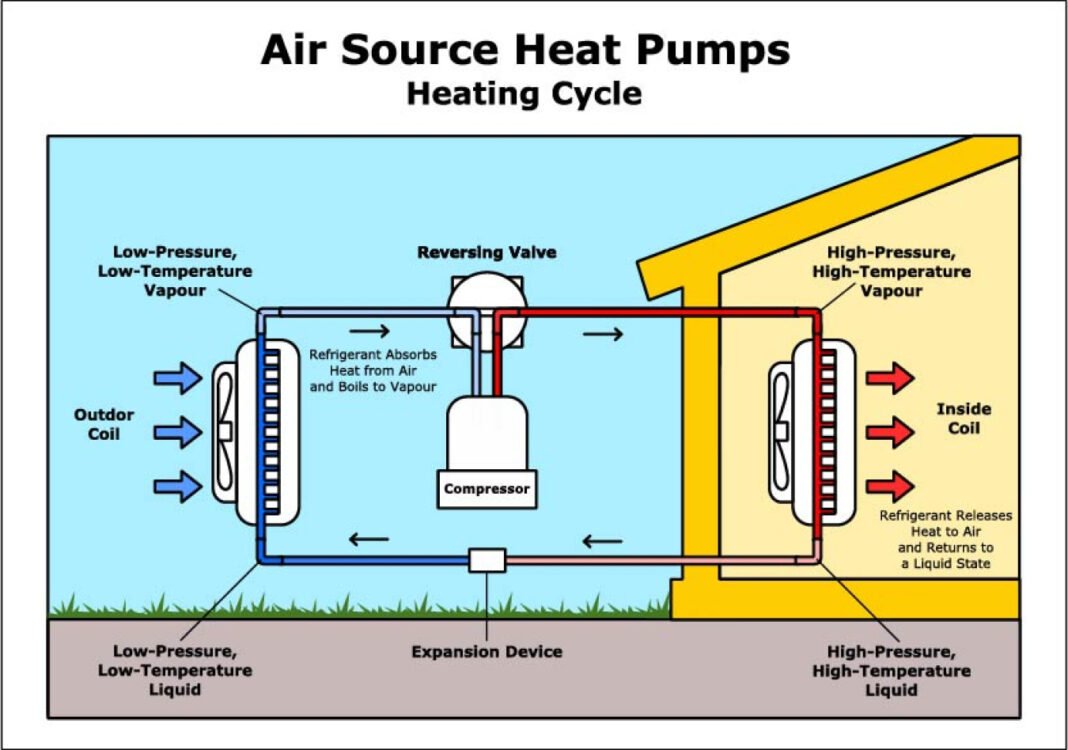
Removes heat from a building’s chilled-water loop via a vapor-compression (or absorption) cycle and rejects it to air (air-cooled) or water (water-cooled/tower).
2) Main classifications
- By heat rejection
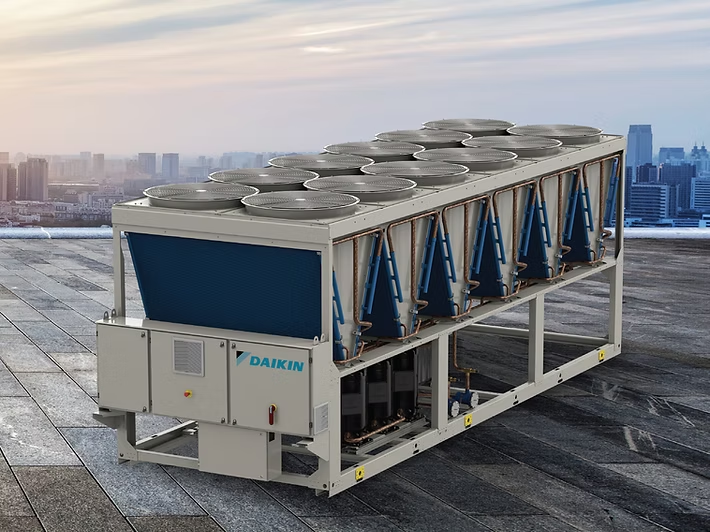
- Air-cooled: Outdoor condenser coils + fans; quick install; higher kW/ton; great where water is scarce.
- Water-cooled: Condenser water loop + cooling tower; higher efficiency; more infra/maintenance.
- Evaporative-cooled: Hybrid (less common).
- By compressor
- Centrifugal (large tonnage, high efficiency, oil or magnetic bearings).
- Screw/rotary (mid-to-large, solid part-load).
- Scroll (small-to-mid, modular).
- Reciprocating (legacy/small).
- By drive/source
- Electric (most common), steam/absorption (waste heat/CHP integration).
- Special
- Heat-recovery chillers (simultaneous cooling + hot water).
- Turbocor/magnetic-bearing (ultra-low part-load power, low maintenance).
3) Core components (what to look for)
- Compressor (type, bearings, VFD).
- Evaporator (shell-and-tube or brazed plate; insulation, freeze protection).
- Condenser (tube materials, water quality).
- Expansion device (EEV vs TXV).
- Controls (BMS integration, safeties, trending).
- Accessories: oil management, purge unit (centrifugal), vibration isolation.
4) Performance metrics & quick math
- Cooling capacity:
Tons=500×GPM×ΔTCHW12,000\text{Tons} = \dfrac{500 \times \text{GPM} \times \Delta T_{CHW}}{12{,}000}Tons=12,000500×GPM×ΔTCHW - Flow thumb rules:
- Chilled water: GPM≈24×TonsΔTCHW(°F)\text{GPM} \approx 24 \times \dfrac{\text{Tons}}{\Delta T_{CHW}(°F)}GPM≈24×ΔTCHW(°F)Tons
(e.g., 12°F ΔT ⇒ ~2 GPM/ton; 10°F ⇒ ~2.4 GPM/ton) - Condenser water: 2.5–3.0 GPM/ton (range 9–12°F typical)
- Chilled water: GPM≈24×TonsΔTCHW(°F)\text{GPM} \approx 24 \times \dfrac{\text{Tons}}{\Delta T_{CHW}(°F)}GPM≈24×ΔTCHW(°F)Tons
- Efficiency:
- kW/ton (lower = better) and COP = 3.517 / (kW/ton).
- IPLV/NPLV for part-load (plant rarely at 100%—optimize for 30–70%).
- Approach temps:
- Evap approach (CHWS – evap sat), Cond approach (cond sat – CWS out).
- Tighter approach = better HX/tube cleanliness.
5) Refrigerants (selection notes)
- Favor low-GWP options (e.g., R-1234ze, R-514A, newer A2L blends) where code-permitted.
- Ensure ASHRAE 34 safety classification, charge limits, ventilation, leak detection, and local code compliance.
6) Plant configurations (controls matter more than bronze)
- Primary–secondary: Constant chiller flow; variable secondary loop. Stable, easy to retrofit.
- Variable primary flow (VPF): Fewer pumps, better part-load. Needs min-flow protection/bypass logic per chiller.
- Series counterflow chillers: Excellent lift reduction at part-load in high ΔT systems.
- Heat-recovery: Use condenser heat for DHW/reheat (shoulder seasons = big wins).
- Tower control (water-cooled):
- Condenser water setpoint reset toward ambient wet-bulb (respect min LMTD/cond approach).
- Fans VFD; cell staging; freeze protection.
7) Water-side design (numbers you use every day)
- CHW ΔT: 12–16°F modern designs (legacy 10°F). Higher ΔT = smaller pipes/pumps, better plant IPLV.
- Design velocities:
- CHW mains: ~6–10 ft/s (balance noise/head).
- Condenser water: ~6–8 ft/s (mitigate fouling, erosion).
- Evaporator/Condenser tubes: 3–12 ft/s (per OEM water quality).
- Pump heads: Sum coil/valve/HX + risers + fittings + safety margin; keep NPSH available > NPSH required.
- Water quality: Filtration, side-stream filters, chemical treatment, biocide, tube material compatibility (CuNi/SS).
8) Electrical & controls integration
- VFD on compressors (screw/centrifugal) + VFD on pumps and tower fans.
- BMS points: starts/stops, safeties, kW, entering/leaving temps, ΔP, valve positions, alarms, trend logs.
- Sequencing: Start smallest/highest-IPLV first, load to sweet spot (e.g., 0.5–0.7 kW/ton), then enable next.
- Setpoint strategies:
- CHWS reset upward when loads are light and coils still satisfy (e.g., 42→46°F).
- DP reset on CHW loop from most-open valve feedback.
9) Selection workflow (10 steps)
- Define load profile (peak vs typical, diversity, growth).
- Choose air- vs water-cooled (site water/space/noise/efficiency).
- Pick ΔT targets (CHW 12–16°F; CW range 9–12°F; approach 5–7°F).
- Estimate flows (GPM) & pump heads.
- Shortlist compressor tech (efficiency, turndown, acoustics, maintenance).
- Check ambient/wet-bulb bins and part-load—optimize IPLV/NPLV.
- Validate refrigerant (safety class, codes).
- Lay out plant topology (VPF vs P-S, headers, bypass, strainers, expansion tank).
- Plan controls & sequences (resets, staging, min-flow).
- Life-cycle cost: CapEx + energy + water + maintenance (10–20 yrs).
10) Commissioning checklist (abridged)
- Piping flushed; strainers clean; air vents/air separator working.
- Sensor calibration (temp, DP, flow).
- Pump curves verified; VFD min/max set; no hunting.
- Chiller safeties & interlocks proven (flow, freeze, surge, oil).
- Tower: cell isolation, basin heaters, level controls, drift eliminators, water treatment online.
- Trend logs enabled (kW/ton, CHWS/L, CWS/L, DP, valve positions).
11) O&M essentials
- Routine: tube cleaning (condenser more frequent), water treatment, oil/refrigerant analysis (as applicable), vibration & bearing checks, purge op (centrifugal), strainer cleaning.
- Keep ΔT high: fix 3-way valves, balance coils, reset DP.
- Typical faults & quick pointers:
- Low ΔT (“low ΔT syndrome”): oversized 3-way coils, bypassing, poor balancing ⇒ convert to 2-way, tune valves, DP reset.
- High kW/ton: dirty tubes, high lift (too warm CW), non-condensables, wrong CHWS setpoint.
- Nuisance trips: unstable flow (VPF min-flow), sensor drift, air in system.
12) Mini case study (sample sizing)
Goal: 1,200-ton water-cooled plant, CHW ΔT = 12°F, CW range = 10°F.
- CHW flow: ≈24×1200/12≈2,400\approx 24 \times 1200 / 12 \approx 2{,}400≈24×1200/12≈2,400 GPM.
- CW flow: ~3 GPM/ton ⇒ ~3,600 GPM.
- Tower: Size for ~1,200 tons at design WB; approach 5–7°F; VFD fans + multi-cell.
- Topology: 3 × 400-ton centrifugal/screw with VFD, VPF piping, DP reset, CHWS reset 42→46°F.
- Expected: <0.55–0.65 kW/ton at typical loads if tubes clean and resets active.
13) Templates you can reuse
A) Submittal review essentials
- Rated tons @ ARI conditions, IPLV/NPLV, sound power, min leaving CHWS, min/max flows, min-flow protection, approach temps, allowable glycol %, short-circuiting tolerance, E-stop & safeties, BACnet points list.
B) Controls sequence (snip)
- Enable chiller when: CHW loop ΔP < setpoint OR warmest zone valve > 90% for 5 min.
- Stage logic: Load first unit to 65–75% before starting next; unload last on with falling load.
- Resets:
- CHWS = 42–46°F based on warmest SAT/valve position.
- CW setpoint = WB + approach, bounded by min LMTD & OEM min cond water.
C) Maintenance schedule (high level)
- Weekly: trends review (kW/ton, ΔT), strainers, visual leaks.
- Monthly: water chemistry, tower drift & fill inspection, vibration trend.
- Quarterly: tube delta-P review, oil/refrig sample (per OEM), test safeties.
- Annual/off-season: tube cleaning, eddy-current test (as needed), calibration.