
1. Introduction
Ventilation requirements define the minimum outdoor air (fresh air) rates that must be supplied to occupied spaces to maintain acceptable Indoor Air Quality (IAQ).
- ASHRAE Standard 62.1 → Global benchmark for ventilation design in commercial/institutional buildings.
- Local Codes → Authorities in each country (Dubai Municipality, Qatar Kahramaa, Saudi SASO, Indian NBC, etc.) often adopt ASHRAE with modifications for local climate and energy goals.
2. ASHRAE 62.1 – Key Principles
ASHRAE 62.1 sets outdoor air ventilation rates based on two components:
- Rp (People Outdoor Air Rate): L/s per person (or CFM per person) → based on occupant density.
- Ra (Area Outdoor Air Rate): L/s per m² (or CFM per ft²) → based on building/space type.
Equation: Voz=(Rp×Pz)+(Ra×Az)V_{oz} = (R_p \times P_z) + (R_a \times A_z)Voz=(Rp×Pz)+(Ra×Az)
Where:
- VozV_{oz}Voz = Zone Outdoor Airflow
- PzP_zPz = Zone population (number of people)
- AzA_zAz = Zone floor area
3. Typical ASHRAE 62.1 Ventilation Rates
| Space Type | Rp (L/s per person) | Ra (L/s per m²) | Approx. ACH | Notes |
|---|---|---|---|---|
| Office Spaces | 2.5 (≈ 5 CFM/person) | 0.3 (≈ 0.06 CFM/ft²) | 3–4 ACH | Based on density of ~5 people/100 m² |
| Conference Rooms | 3.8 (≈ 7.5 CFM/person) | 0.3 | 6–8 ACH | Higher occupancy → higher Rp |
| Classrooms (Ages 9+) | 5.0 (≈ 10 CFM/person) | 0.6 | 6–10 ACH | To maintain CO₂ <1000 ppm |
| Healthcare (Patient Room) | 5.0 | 0.6 | 6 ACH min | ASHRAE 170 applies in detail |
| Hospital Operating Room | 5.0 | 0.6 | 20 ACH min | 100% fresh air, HEPA required |
| Retail (Mall) | 3.8 | 0.3 | 6–10 ACH | Crowd density factor applied |
| Restaurants/Dining | 5.0 | 0.6 | 8–12 ACH | Kitchen exhaust separately |
| Laboratories | N/A | Code-based | 6–12 ACH | Ventilation based on fume hoods |
| Toilets/Restrooms | N/A | Exhaust-based | 10 ACH min | Negative pressure required |
4. Local Codes and Adjustments
- UAE (Dubai Municipality, DM Code): Based on ASHRAE 62.1, but minimum fresh air is often 20 CFM/person in offices due to climate and energy recovery requirements.
- Qatar (Kahramaa, Qatar Construction Standards – QCS): Follows ASHRAE but enforces stricter energy efficiency through heat recovery systems.
- Saudi Arabia (SASO, SBC 501/502): Requires energy recovery wheels in FAHUs for high outdoor air volumes (aligning with Vision 2030 sustainability goals).
- India (NBC, ISHRAE): Aligns with ASHRAE but defines ventilation in L/s per person with local climate emphasis.
5. Pressurization Requirements
In addition to outdoor air rates, codes specify air balance to maintain safety and comfort:
- Positive Pressure: Offices, malls, clean rooms.
- Negative Pressure: Toilets, kitchens, isolation rooms.
- Neutral/Controlled Pressure: Data centers, sensitive equipment rooms.
6. Energy Efficiency Requirements
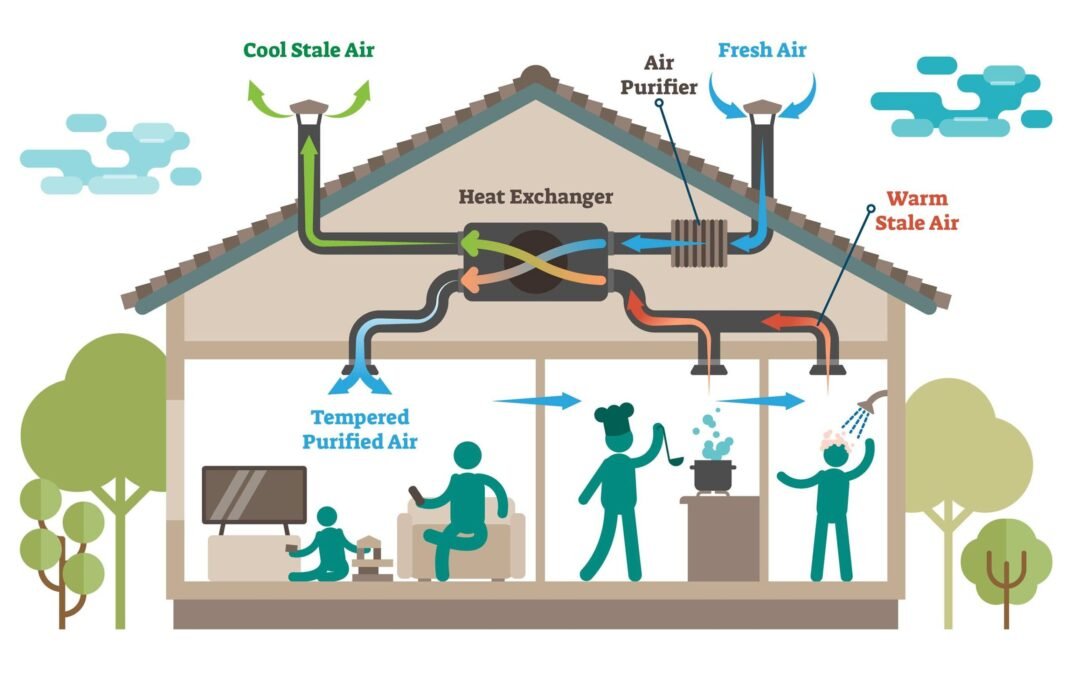
- FAHUs handling large fresh air volumes must use energy recovery systems (heat recovery wheel, run-around coils, plate exchangers).
- Demand-Controlled Ventilation (DCV): Required in many codes → adjusts fresh air supply based on CO₂ sensors.
7. Example Calculation (Office Zone)
- Occupancy: 100 people
- Zone area: 1000 m²
- Rp = 2.5 L/s per person → 2.5×100=250 L/s2.5 × 100 = 250 \, L/s2.5×100=250L/s
- Ra = 0.3 L/s per m² → 0.3×1000=300 L/s0.3 × 1000 = 300 \, L/s0.3×1000=300L/s
- Total Voz=250+300=550 L/sV_{oz} = 250 + 300 = 550 \, L/sVoz=250+300=550L/s = 1165 CFM
This fresh air requirement will then guide FAHU capacity sizing.