
1. What is a Mixing Box?
- A mixing box is a section inside an AHU (or hybrid FAHU) where outdoor (fresh) air and return air from the building are mixed in controlled proportions before further conditioning.
- Equipped with dampers and sometimes actuators, it helps optimize IAQ, energy efficiency, and pressurization.
👉 Note: In a true FAHU (100% outdoor air), there is usually no return air mixing. Mixing boxes are mostly in AHUs or FAHUs with partial return-air operation (energy-saving designs).
2. Purpose of a Mixing Box
- Ventilation Control: Ensures correct fresh air percentage as per ASHRAE 62.1 / local codes.
- Energy Efficiency: Reduces energy use by mixing conditioned return air with fresh air.
- Pressurization Control: Helps maintain positive/negative pressure in zones by adjusting airflow balance.
- Flexibility: Allows operation in different modes:
- 100% fresh air (purge mode).
- 100% return air (recirculation mode).
- Mixed mode (normal operation).
3. Components of a Mixing Box
- Fresh Air Damper: Controls the volume of outdoor air entering.
- Return Air Damper: Controls the volume of air recirculated from occupied spaces.
- Exhaust/Relief Air Damper: Balances excess air to maintain correct building pressure.
- Actuators: Motorized devices that adjust damper positions automatically.
- Mixing Section: Chamber where fresh and return air streams combine before hitting filters and coils.
4. Damper Arrangement
The typical damper arrangement includes:
- Fresh Air Damper (connected to outside air intake).
- Return Air Damper (connected to duct bringing air back from zones).
- Exhaust/Relief Damper (to discharge excess air outdoors).
👉 Dampers are interlinked (opposed blade type):
- When fresh air damper opens more, the return air damper closes proportionally, and vice versa.
- Controlled by BMS actuators for automatic modulation.
5. Modes of Operation
- Normal Mode (Mixed):
- Fresh air: ~20–30%
- Return air: ~70–80%
- Exhaust damper: opens as needed.
- 100% Fresh Air Mode (Purge):
- Fresh air damper fully open.
- Return damper closed.
- Exhaust damper fully open.
- Used in emergencies (e.g., smoke purge, contamination).
- 100% Recirculation Mode (Energy Saving):
- Return damper fully open.
- Fresh air damper closed.
- Exhaust damper closed.
- Used during unoccupied hours (not allowed for critical spaces).
6. Application Examples
- Office Buildings:
Mixing box allows 20–30% fresh air intake while reusing return air for energy savings. - Hospitals:
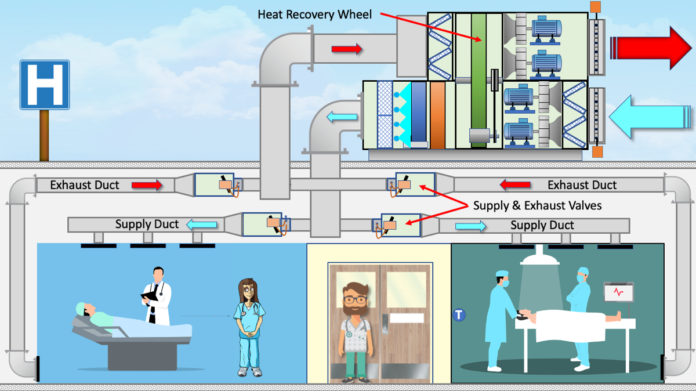
- Operating rooms → FAHUs supply 100% fresh air (no mixing box).
- General areas → AHUs may use mixing boxes to balance energy and IAQ.
- Industrial Facilities:
- Clean rooms use minimal or no return mixing.
- General zones may mix filtered return air.
7. Example Air Balance
For a 10,000 CFM AHU:
- Fresh air damper → 2,000 CFM (20%).
- Return air damper → 8,000 CFM (80%).
- Exhaust damper → balances excess to maintain neutral/positive pressure.
8. Key Design Considerations
- Dampers must be low leakage type for accuracy.
- Proper air sealing in mixing box is essential to prevent bypass.
- Differential pressure sensors may be used to monitor outside vs. inside airflow.
- Mixing should be even to prevent hot/cold spots on coils (use baffles or air mixers if needed).