
1. What is Pressure Drop?
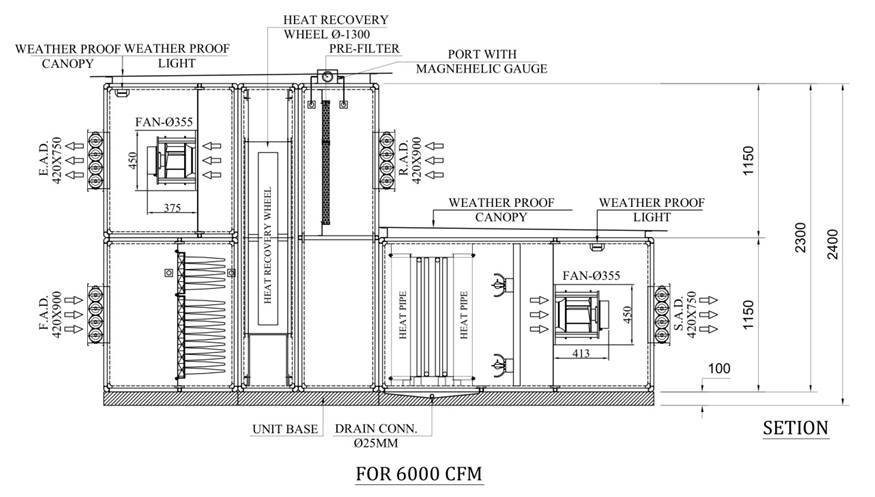
- Definition: Pressure drop is the resistance to airflow caused by FAHU components such as filters, coils, dampers, and duct connections.
- Units: Pascals (Pa) or Inches of Water Gauge (in. w.g.).
- Key Point: As components get dirty (filters clog, coils foul), pressure drop increases, airflow reduces, and the fan consumes more energy.
2. Sources of Pressure Drop in FAHU
- Filters:
- Clean pre-filter: 50–100 Pa
- Fine filter: 100–200 Pa
- HEPA filter: 250–400 Pa
- Cooling/Heating Coils: 50–100 Pa (depends on coil rows & fin density).
- Dampers & Silencers: 20–60 Pa.
- Ductwork & Accessories: Adds extra resistance to be considered in total static pressure.
3. Monitoring Pressure Drop
- Differential Pressure Gauges (Magnehelic): Installed across filter banks and coils.
- Differential Pressure Transmitters (DPTs): Provide real-time data to the BMS (Building Management System).
- Setpoints for Action:
- Pre-filter: Replace/clean at 150–200 Pa.
- Fine filter: Replace at 250–300 Pa.
- HEPA: Replace at >400 Pa.
- Warning: Operating with clogged filters → reduced ventilation, IAQ failure, and excessive fan energy.
4. Effects of High Pressure Drop
- Increased fan power consumption (higher kW demand).
- Reduced air supply → occupants feel discomfort, IAQ worsens.
- Risk of condensation & microbial growth on coils due to low airflow.
- Overheating of fan motors if prolonged.
- Shorter lifespan of filters, fans, and motors.
5. Maintenance Practices
🔹 Filters
- Pre-filters: Wash/replace every 1–3 months.
- Fine filters: Replace every 6–12 months.
- HEPA filters: Replace every 12–24 months (not washable).
- Always check ΔP across filters before replacement.
🔹 Coils
- Clean cooling/heating coils every 6–12 months to remove dust, biofilm, and scale.
- Maintain clean drain pans to avoid bacterial growth (Legionella risk).
🔹 Fans & Dampers
- Inspect fan belts, bearings, and VFDs every 3 months.
- Check damper operation and actuator calibration.
🔹 General
- Inspect casing and access doors for air leakage.
- Verify differential pressure sensors regularly.
6. Example: Office Building FAHU
- Design airflow: 10,000 CFM.
- Initial filter ΔP: 200 Pa.
- After 6 months, ΔP rises to 400 Pa → airflow drops to 7,000 CFM.
- Result: Occupants complain of “stuffy” rooms, energy bill rises due to fan overwork.
- Solution: Filter replacement restores airflow and reduces fan power.
7. Recommended Maintenance Schedule
| Component | Check Frequency | Action |
|---|---|---|
| Pre-Filters | Monthly | Wash/replace if ΔP > 150 Pa |
| Fine Filters | Quarterly | Replace if ΔP > 250 Pa |
| HEPA Filters | 6–12 months | Replace if ΔP > 400 Pa |
| Cooling/Heating Coils | Every 6 months | Clean with coil cleaner, flush drain pans |
| Fans/Blowers | Quarterly | Lubricate, check belts, vibration, VFD |
| Dampers | Quarterly | Inspect blade operation & actuators |
✅ Summary:
- Pressure drop is a key performance indicator in FAHUs.
- Monitoring with gauges/sensors ensures timely action before airflow/IAQ problems occur.
- Preventive maintenance (filters, coils, fans) reduces energy cost, maintains IAQ, and extends system life.