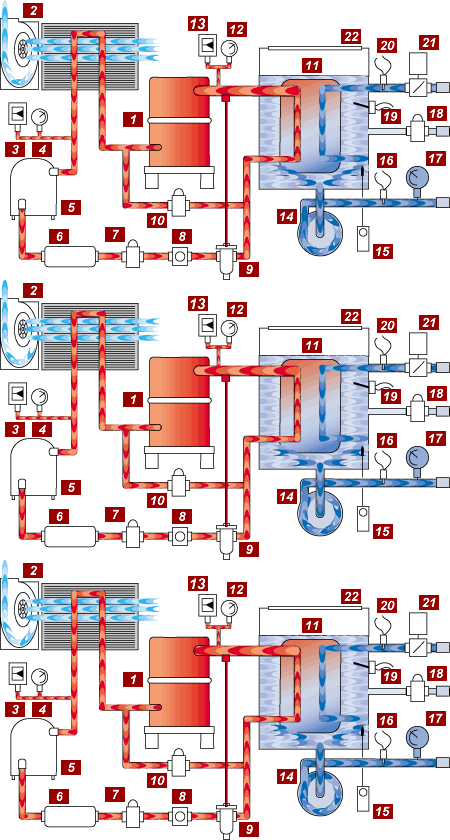

A Chilled Water System is widely used in HVAC (Heating, Ventilation, and Air Conditioning) for medium to large facilities like commercial buildings, hospitals, industrial plants, and data centers. The system provides cooling via chilled water circulated to air handling units (AHUs), fan coil units (FCUs), or other terminal devices. Here’s a structured guide to designing a chilled water system:
1. Basic Components of a Chilled Water System
| Component | Function |
|---|---|
| Chillers | Produce chilled water by removing heat from water. |
| Cooling Towers (if water-cooled) | Reject heat from the chiller to the atmosphere. |
| Pumps | Circulate chilled and condenser water. |
| Piping Network | Distributes chilled water throughout the building. |
| AHUs / FCUs | Terminal units that transfer chilled water cooling to air. |
| Control Valves | Regulate flow to various branches and units. |
| Expansion Tanks | Manage system pressure and accommodate water volume changes. |
2. Types of Chilled Water Systems
a. Primary-Only System
- Simpler, lower cost, used for smaller systems.
- Single loop and set of pumps.
b. Primary-Secondary System
- Separate loops for chillers (primary) and building distribution (secondary).
- Allows better flow control and chiller staging.
c. Variable Primary Flow (VPF)
- Single loop but with variable-speed pumps.
- Reduces pumping energy.
3. Design Steps
✅ Step 1: Load Estimation
- Calculate building cooling load (BTU/hr or TR).
- Consider internal loads (people, lights, equipment) and external loads (solar, infiltration).
✅ Step 2: Chiller Selection
- Select based on total load, redundancy, and future capacity.
- Decide between air-cooled (simpler, smaller loads) or water-cooled (efficient, larger loads).
✅ Step 3: Piping Design
- Loop type: Primary only, Primary/Secondary, VPF.
- Material: Steel, copper, HDPE.
- Pipe sizing: Based on flow rate, velocity (6-10 ft/s typical), and pressure drop.
- Include balancing valves, manual/automatic air vents, drain valves.
✅ Step 4: Pump Selection
- Based on total flow rate and pressure loss (head).
- Redundancy (N+1 design often used).
- Consider variable frequency drives (VFDs) for efficiency.
✅ Step 5: Control Strategy
- Chiller sequencing and staging.
- Differential pressure sensors for pump speed control.
- Control valves at AHUs/FCUs (2-way or 3-way).
4. System Flow Rate Calculation
Formula:
Flow Rate (GPM)=Cooling Load (BTU/hr)500×ΔT(°F)\text{Flow Rate (GPM)} = \frac{ \text{Cooling Load (BTU/hr)} }{ 500 \times \Delta T (\text{°F}) }Flow Rate (GPM)=500×ΔT(°F)Cooling Load (BTU/hr)
- 500: Constant (water properties).
- ΔT: Temperature difference (commonly 10°F for comfort cooling).
Example:
For 1,000,000 BTU/hr load, ΔT = 10°F: Flow Rate=1,000,000500×10=200 GPM\text{Flow Rate} = \frac{1,000,000}{500 \times 10} = 200 \, \text{GPM}Flow Rate=500×101,000,000=200GPM
5. Chiller and Cooling Tower Selection
- Chillers: Sized for full or partial load, N+1 redundancy.
- Cooling towers (if applicable): Sized to reject heat absorbed by condenser water loop.
6. Energy Efficiency Considerations
- High-efficiency chillers (variable-speed compressors).
- VFDs on pumps and fans.
- Economizers (using outside air when cool enough).
- Proper insulation for chilled water piping.
- Control optimization (Building Management System – BMS).
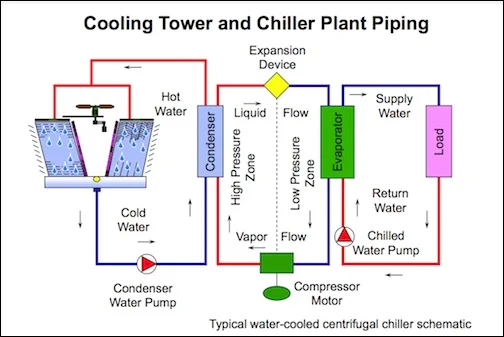
7. Typical Chilled Water System Diagram (Conceptual)
Chillers ---> Primary Pumps ---> Building Load (AHUs, FCUs) ---> Return to Chillers
                         |
                 (Optional Secondary Loop)
                         |
                  Cooling Tower (if water-cooled)
8. Common Design Mistakes to Avoid
- Oversizing/undersizing chillers.
- Not accounting for future expansion.
- Poor pipe sizing, leading to high pressure drops.
- Lack of redundancy in critical systems.
- Ignoring water treatment for scale and corrosion control.
9. Chilled Water System Design Tools and Software
- TRACE 700, HAP (Hourly Analysis Program) for load estimation.
- AutoPIPE, PipeFlow for hydraulic analysis.
- Revit MEP, AutoCAD MEP for system modeling.
- Energy modeling tools (EnergyPlus, IES VE).