
A Hybrid VRF system is an advanced air conditioning solution that combines refrigerant-based VRF (Variable Refrigerant Flow) technology with a water-based secondary distribution system.
- Outdoor units use refrigerant (as in traditional VRF).
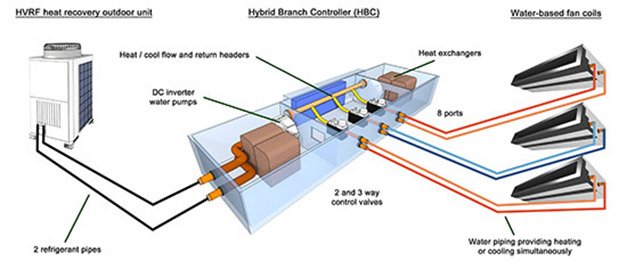
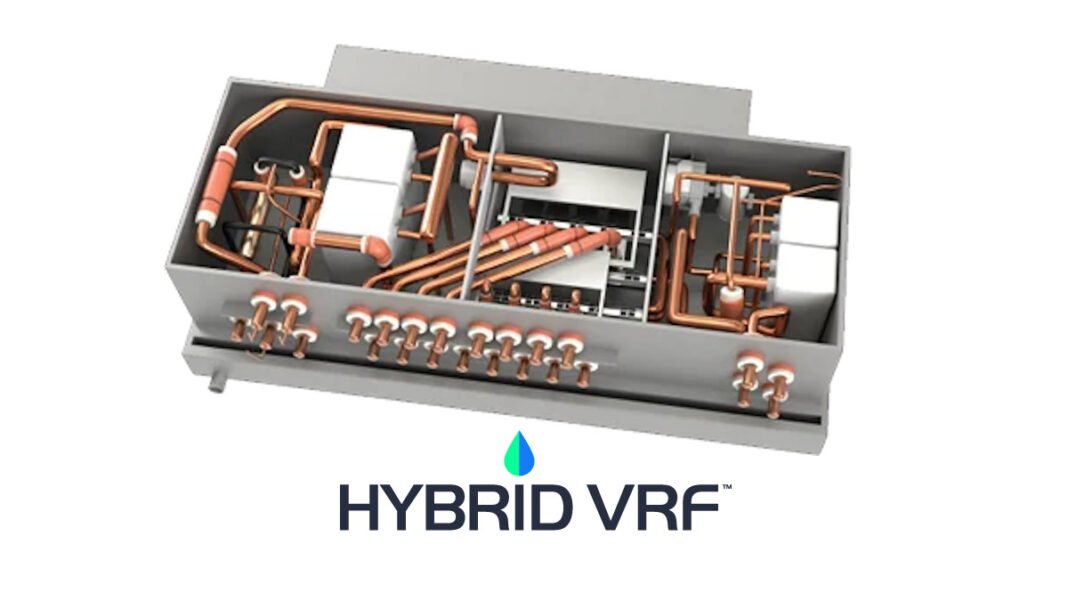
- Instead of sending refrigerant directly to all indoor units, it connects to a Hybrid Branch Controller (HBC).
- The HBC converts refrigerant energy → into chilled or heated water, which is circulated to indoor fan coil units.
👉 This reduces the amount of refrigerant inside the building while keeping VRF’s zoning, flexibility, and energy efficiency.
🔹 System Components
- VRF Outdoor Units
- Use inverter-driven compressors.
- Supply refrigerant to the HBC (not directly to rooms).
- Hybrid Branch Controller (HBC Unit)
- Acts as a “heat exchanger” between refrigerant loop and water loop.
- Supplies chilled or heated water to fan coils.
- Allows simultaneous heating & cooling (heat recovery).
- Indoor Units (Fan Coil Units)
- Use water (not refrigerant).
- Types: ducted, cassette, wall-mounted, ceiling-suspended, etc.
- Control System (BMS / VRF Controller)
- Optimizes operation, zoning, and energy use.
🔹 Working Principle
- Refrigerant is circulated between outdoor VRF unit → HBC.
- The HBC transfers energy to a closed-loop water system.
- Water is pumped to indoor fan coils for heating/cooling.
- Multiple zones can have different setpoints:
- Some spaces cooled.
- Others heated (simultaneous mode).
🔹 Advantages of HVRF Systems
✅ Low Refrigerant Volume Indoors
- Only water runs through indoor piping → safer in healthcare, schools, high-rise towers.
✅ Regulatory Compliance
- Meets F-Gas regulations and refrigerant leak safety codes.
✅ Energy Efficiency
- Inverter-driven VRF compressors.
- Heat recovery between zones → reuses waste heat.
✅ Flexibility & Comfort
- Individual room temperature control.
- Long piping runs (similar to VRF).
✅ Lower Running Costs
- Optimizes operation based on demand.
- Uses water (high heat transfer efficiency) for indoor distribution.
✅ Reduced Environmental Impact
- Less refrigerant → lower GWP impact.
🔹 Applications
- High-rise buildings (hotels, offices, residential towers).
- Hospitals & healthcare facilities (where refrigerant safety is critical).
- Universities, schools, data centers (safety + efficiency).
- Mega projects (Dubai, NEOM, Qatar, etc.) seeking green building standards.
🔹 Comparison: VRF vs HVRF
| Feature | VRF | Hybrid VRF (HVRF) |
|---|---|---|
| Indoor Distribution | Refrigerant | Water |
| Refrigerant Safety Concerns | Higher (indoors) | Lower (contained in HBC) |
| Compliance with Low-GWP Laws | Limited | High |
| Simultaneous Heating & Cooling | Yes (heat recovery VRF) | Yes (via HBC) |
| Maintenance | Specialized refrigerant work | Easier (water loop indoors) |
| Best For | Standard offices, homes | Large/high-rise, healthcare, schools |
✅ In short:
A Hybrid VRF system = VRF outdoor + water indoor.
It’s a safe, efficient, and future-proof alternative to standard VRF, especially in large or regulated projects.