1. What is Ventilation?
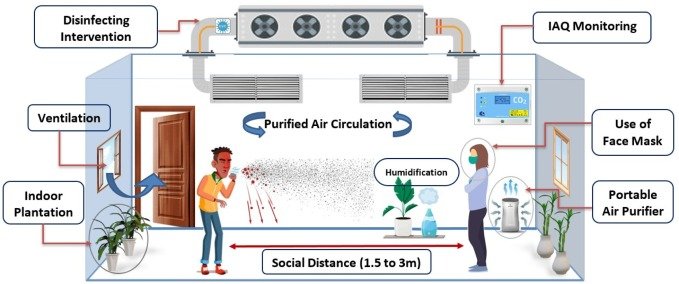
Ventilation is the process of supplying fresh outdoor air into an indoor space and removing stale indoor air, in order to maintain:
- Indoor Air Quality (IAQ)
- Thermal comfort
- Health & safety of occupants
In HVAC design, ventilation is provided using systems such as FAHUs, AHUs, exhaust fans, and natural ventilation methods.
2. Purposes of Ventilation
- Dilution of contaminants: Removes CO₂, VOCs, odors, and smoke.
- Oxygen replenishment: Maintains breathable air quality.
- Moisture control: Helps prevent mold growth and condensation.
- Temperature and humidity regulation: Works with HVAC systems to condition air.
- Pressurization: Maintains positive/negative pressure in sensitive areas (hospitals, labs).
3. Types of Ventilation
🔹 a. Natural Ventilation
- Achieved by openings such as windows, vents, or louvers.
- Driven by wind pressure and thermal buoyancy.
- Limitations: uncontrollable, climate-dependent, poor in high-rise or sealed buildings.
🔹 b. Mechanical Ventilation
- Driven by fans and duct systems.
- Types:
- Exhaust ventilation → removes stale air (kitchens, toilets).
- Supply ventilation → provides filtered, conditioned outdoor air (FAHU).
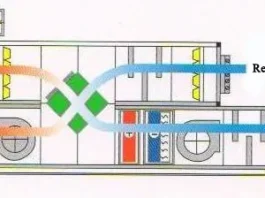
- Balanced ventilation → supply + exhaust with heat recovery (ERV/HRV).
4. Ventilation Air Components in HVAC
- Fresh Air (Outdoor Air): Clean air drawn from outside.
- Return Air: Air taken back from occupied spaces.
- Exhaust Air: Contaminated air discharged outdoors.
- Relief Air: Excess air vented to balance indoor pressure.
5. Ventilation Requirements & Standards
Ventilation rates depend on occupancy type, density, and building codes.
- ASHRAE 62.1 – Ventilation for Acceptable IAQ: Defines minimum outdoor air per person and per area.
- WHO & Local Codes: Often stricter for healthcare and industrial spaces.
🔹 Rule of Thumb:
- Offices: 8–10 L/s per person (≈15–20 CFM/person)
- Hospitals: 12–15 ACH (Air Changes per Hour) for patient rooms
- Labs: 6–12 ACH depending on use
6. Psychrometric Process of Ventilation
When outdoor air enters a building:
- It is filtered to remove dust and contaminants.
- It passes through cooling/heating coils to adjust temperature.
- It may undergo dehumidification or humidification.
- It is distributed via ductwork into occupied spaces.
The psychrometric chart helps visualize air properties (dry-bulb temperature, wet-bulb temperature, humidity ratio, enthalpy) during these processes.
7. Pressurization through Ventilation
- Positive Pressure: Supplying more air than exhausted → prevents infiltration of hot/humid/polluted air (offices, malls, clean zones).
- Negative Pressure: Exhausting more air than supplied → isolates contaminants (toilets, isolation rooms, labs).
8. Energy & Ventilation
- Ventilation consumes significant energy because outdoor air must be fully conditioned.
- Solutions to improve efficiency:
- Energy Recovery Ventilators (ERV/HRV)
- Demand-Controlled Ventilation (DCV) using CO₂ sensors
- Variable Air Volume (VAV) systems
9. Practical Example
- Office Building: FAHU supplies 20% outdoor air → mixed with 80% return air in AHU → delivered to occupied zones.
- Hospital Operating Room: FAHU provides 100% outdoor air → passes through HEPA filters → maintains positive pressure relative to surrounding corridors.