1. Why Heat Recovery?
- FAHUs handle 100% fresh outdoor air.
- In hot-humid climates (e.g., Middle East, Asia), this air requires significant cooling and dehumidification.
- In cold climates, outdoor air needs heating and humidification.
- Without recovery, this is highly energy-intensive.
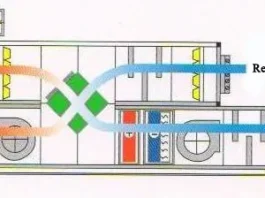
- Heat Recovery Systems (HRS) transfer energy between exhaust air (leaving the building) and fresh air (entering the building), reducing the load on cooling/heating coils.
2. Benefits of Heat Recovery
- Energy Efficiency: 20–70% energy savings (depending on system).
- Reduced Operating Cost: Cuts cooling/heating plant loads.
- Improved IAQ: Allows higher ventilation rates without huge energy penalties.
- Sustainability: Supports LEED, WELL, Estidama, and Vision 2030 green building goals.
- Mandatory in Codes: Many regions (UAE, Qatar, Saudi) require heat recovery in FAHUs with >20% outdoor air fraction.
3. Types of Heat Recovery Systems
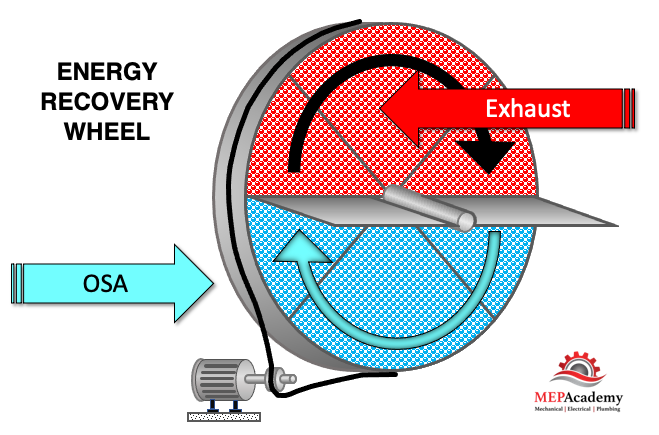
🔹 a. Rotary Energy Recovery Wheel (Enthalpy Wheel)
- Rotating wheel made of heat-absorbing material.
- Transfers sensible (temperature) + latent (moisture) energy.
- Efficiency: 70–80%.
- Applications: Offices, malls, airports.
- Pros: High efficiency, compact.
- Cons: Possible cross-contamination if not sealed properly.
🔹 b. Plate Heat Exchanger
- Parallel plates separate supply and exhaust air streams.
- Transfers only sensible heat (temperature).
- Efficiency: 50–70%.
- Applications: Hospitals, cleanrooms (no cross-contamination).
- Pros: No moving parts, hygienic.
- Cons: No latent transfer, larger footprint.
🔹 c. Heat Pipe Heat Exchanger
- Uses sealed copper tubes with refrigerant.
- Transfers heat by evaporation–condensation cycle.
- Efficiency: 45–65%.
- Applications: Compact FAHUs, data centers.
- Pros: Simple, reliable, no moving parts.
- Cons: Only sensible transfer, orientation-dependent.
🔹 d. Run-Around Coil System
- Two separate coils (one in exhaust, one in supply), connected by water/glycol loop with pump.
- Efficiency: 45–60%.
- Applications: When supply and exhaust ducts are far apart.
- Pros: No cross-contamination, flexible layout.
- Cons: Lower efficiency, higher maintenance (pump, piping).
4. Comparison Table
| System | Heat Type | Efficiency | Cross-Contamination Risk | Best For |
|---|---|---|---|---|
| Rotary Wheel | Sensible + Latent | 70–80% | Medium (if leakage occurs) | Offices, malls |
| Plate Heat Exchanger | Sensible Only | 50–70% | Very Low | Hospitals, labs |
| Heat Pipe | Sensible Only | 45–65% | None | Data centers, compact FAHUs |
| Run-Around Coil | Sensible Only | 45–60% | None | Separated exhaust/supply ducts |
5. Example: Office Tower in Hot Climate (Dubai/Qatar)
- Outdoor air: 42°C DB, 26°C WB.
- Indoor air: 24°C, 50% RH.
- FAHU with rotary wheel recovers cooling energy from exhaust air at 24°C → reduces entering air load to ~30°C before it hits cooling coil.
- Result: 30–40% reduction in chiller load.
6. Example: Hospital (Clean Zone)
- FAHU uses plate heat exchanger to recover sensible energy from exhaust air without risk of contamination.
- Maintains sterile air supply while saving 25–30% cooling/heating energy.
7. Integration with BMS & VFDs
- Sensors monitor temperature, humidity, airflow.
- BMS logic controls wheel rotation speed, pump flow, or bypass dampers.
- VFDs adjust fan speed to account for added pressure drop across heat recovery devices.