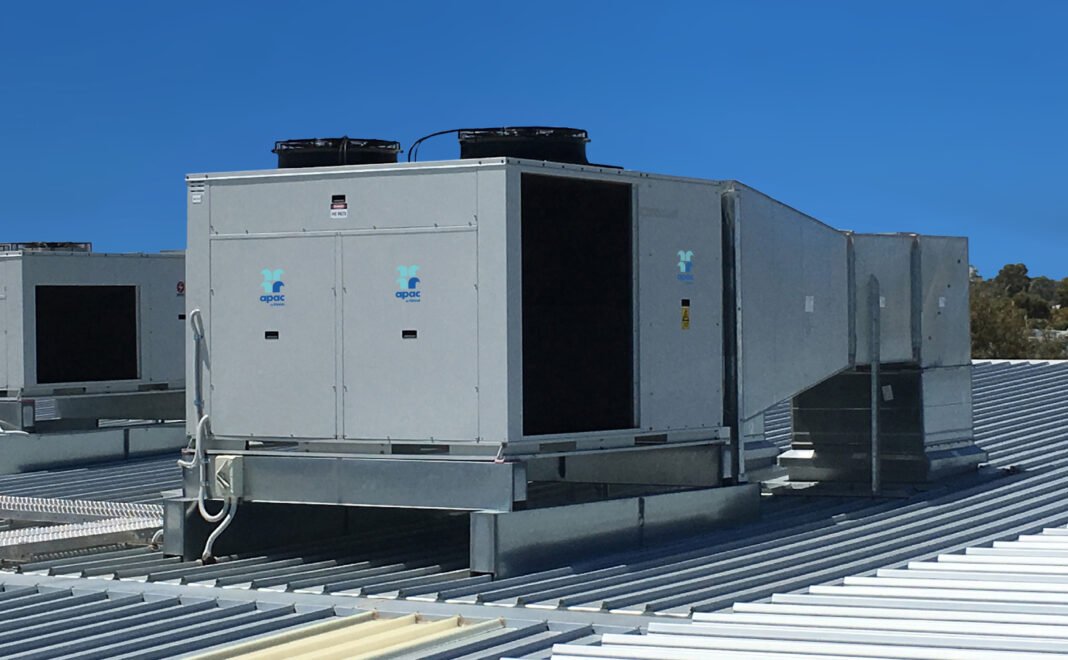


In HVAC systems, Mixed Air Temperature (MAT) refers to the temperature of the air stream that results when two or more airflows of different temperatures are combined before entering the cooling or heating coil of an Air Handling Unit (AHU) or Fan Coil Unit (FCU). Most commonly, this occurs when return air (air coming back from the conditioned space) is mixed with outdoor (fresh) air and sometimes with recirculated exhaust air.
This mixed air is then supplied to the cooling or heating coil for conditioning. The proper calculation and control of MAT is crucial because it determines the coil load, energy consumption, indoor comfort, and ventilation effectiveness.
- Too high MAT → increases cooling load on the coil.
- Too low MAT → can cause coil freezing, condensation issues, or occupant discomfort.
- Correct MAT → ensures energy-efficient operation, adequate ventilation, and stable indoor conditions.
Why is MAT Important?
- Energy Efficiency – Helps optimize the use of return and outdoor air to reduce load on cooling/heating coils.
- Indoor Air Quality (IAQ) – Ensures enough outdoor air is mixed in for proper ventilation per ASHRAE 62.1 or local codes.
- Comfort Control – Provides stable temperature conditions for downstream spaces.
- System Protection – Prevents freezing of coils in cold weather or overheating in hot climates.
Formula for Calculating Mixed Air Temperature
The mixed air temperature is essentially a weighted average based on the proportion (airflow fractions) of each air source: Tmix=(TOA×CFMOA)+(TRA×CFMRA)CFMOA+CFMRAT_{mix} = \frac{(T_{OA} \times CFM_{OA}) + (T_{RA} \times CFM_{RA})}{CFM_{OA} + CFM_{RA}}Tmix=CFMOA+CFMRA(TOA×CFMOA)+(TRA×CFMRA)
Where:
- TmixT_{mix}Tmix = Mixed Air Temperature (°C or °F)
- TOAT_{OA}TOA = Outdoor Air Temperature
- TRAT_{RA}TRA = Return Air Temperature
- CFMOACFM_{OA}CFMOA = Outdoor Airflow (cubic feet per minute)
- CFMRACFM_{RA}CFMRA = Return Airflow
This can also be expressed in terms of fractions of airflow: Tmix=(FOA×TOA)+(FRA×TRA)T_{mix} = (F_{OA} \times T_{OA}) + (F_{RA} \times T_{RA})Tmix=(FOA×TOA)+(FRA×TRA)
Where:
- FOAF_{OA}FOA = Outdoor Air Fraction = CFMOACFMTotal\frac{CFM_{OA}}{CFM_{Total}}CFMTotalCFMOA
- FRAF_{RA}FRA = Return Air Fraction = CFMRACFMTotal\frac{CFM_{RA}}{CFM_{Total}}CFMTotalCFMRA
and FOA+FRA=1F_{OA} + F_{RA} = 1FOA+FRA=1.
Example Calculation
Suppose an AHU is handling 10,000 CFM total supply air.
- Outdoor air intake = 3,000 CFM at 95°F
- Return air = 7,000 CFM at 75°F
Step 1: Find air fractions FOA=300010000=0.3(30%)F_{OA} = \frac{3000}{10000} = 0.3 \quad (30\%)FOA=100003000=0.3(30%) FRA=700010000=0.7(70%)F_{RA} = \frac{7000}{10000} = 0.7 \quad (70\%)FRA=100007000=0.7(70%)
Step 2: Apply formula Tmix=(0.3×95)+(0.7×75)T_{mix} = (0.3 \times 95) + (0.7 \times 75)Tmix=(0.3×95)+(0.7×75) Tmix=28.5+52.5=81°FT_{mix} = 28.5 + 52.5 = 81°FTmix=28.5+52.5=81°F
So, the mixed air temperature entering the coil is 81°F.
Practical Considerations
- Sensors and Controls
- Mixed Air Temperature sensors are typically placed in the mixing box section of the AHU.
- Building Management Systems (BMS) use these readings for economizer control (free cooling) or minimum ventilation.
- Effect of Humidity
- While MAT is primarily temperature-based, in humid climates, the enthalpy method (considering both dry-bulb temperature and humidity ratio) is more accurate.
- Economizer Operation
- If outdoor air is cooler than return air, systems may increase outdoor air intake to reduce cooling energy (free cooling).
- Code Compliance
- ASHRAE and local codes specify minimum outdoor air fractions for ventilation. This sets the baseline MAT that must be achieved.
✅ In summary: Mixed Air Temperature is the combined temperature of outdoor and return air before conditioning. It is calculated as a weighted average based on airflow proportions, and it plays a vital role in HVAC system energy efficiency, comfort, and indoor air quality.